By Admin · 08 Sep 2026
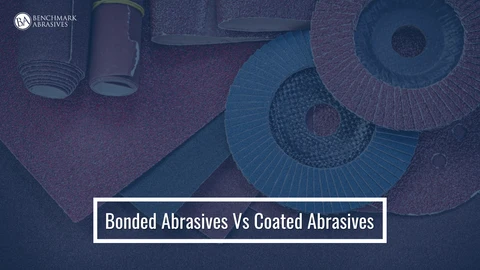
There are two major types of abrasive tools used for surface finishing and material removal. They vary greatly in terms of uses, performance, qualities and their constructions. In this article, we will cover all the details regarding bonded and coated abrasives, their differences and how to choose between them.
Abrasive grains bound together by a bonding agent make up bonded abrasives. This mixture is molded into shapes like wheels, stones, segments, or mounted points, then solidified. Common types include vitrified clay, resin, rubber, and metal. Key features of bonded abrasives are:
Bonded abrasives are a highly versatile tool and can be used for a wide range of applications, including removal of heavy stock, fine finishing, blending, polishing, and deburring of in various sectors, including metal fabrication, tool and die making, automotive and aerospace. The particular bonded abrasive type (material, grit size, bond type, and form) is chosen with care, taking into account the equipment being used, the material being treated, and the intended result.
Coated abrasives are made up of abrasive grains glued to a flexible backing material which can be paper, cloth, fiber, film, plastic, or a mix of these. Adhesives or bonds, sometimes in several layers, are used to stick the grains to the backing. The abrasive grains are available in various sizes (grits) and materials. The following are the key features of coated abrasives:
 Star Materials & Mind